
Evolution of Online Education
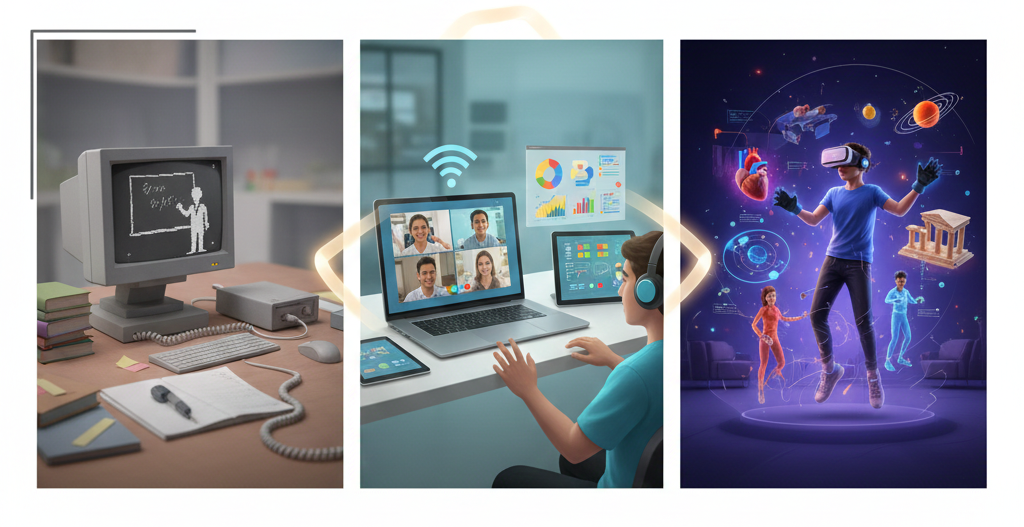
Online education has evolved through multiple stages, shaped by technological progress, social needs, and changing learning behaviors. Its origins can be traced back to correspondence education, a system designed to provide learning opportunities to individuals who could not attend traditional classrooms. In this model, study materials were distributed through postal services, and learners completed assignments independently before mailing them back for evaluation. Although interaction was minimal and feedback was slow, correspondence learning established the core principle that education could be delivered beyond physical institutions, laying the groundwork for future distance learning models.
The next phase of evolution began with the introduction of computers and early digital technologies. Educational institutions started experimenting with computer-based training programs, floppy disks, and CD-ROMs to distribute instructional content. This stage allowed learners to access structured lessons with multimedia elements such as text, images, and basic animations. While internet access was still limited, these developments marked a shift from paper-based learning to digital formats, improving content consistency and learner engagement compared to traditional correspondence methods.
With the expansion of the internet in the late 1990s and early 2000s, online education entered a more dynamic and connected phase. Universities and training institutions began using websites, email communication, and early Learning Management Systems to host course materials, manage assignments, and conduct assessments. This advancement enabled two-way interaction between instructors and learners, significantly enhancing the learning experience. Students could access content remotely, communicate with instructors, and participate in online discussions, making education more flexible and accessible to a broader audience.
As internet speeds improved and multimedia tools advanced, online education became increasingly interactive and immersive. Video lectures, live virtual classes, discussion forums, and digital collaboration tools transformed online learning into an engaging experience rather than a passive one. Learners could interact in real time, revisit recorded sessions, and participate in group activities regardless of geographical location. The widespread adoption of smartphones and mobile applications further expanded access, allowing learners to study anytime and anywhere, thereby integrating education into daily life.
A major turning point in the evolution of online education was the emergence of large-scale online learning platforms offering structured courses to global audiences. These platforms provided professionally designed content, assessments, peer interaction, and certifications, making quality education accessible to millions. This phase helped normalize online education and increased its acceptance among academic institutions, employers, and learners. It also encouraged self-paced learning, enabling individuals to customize their educational journeys based on personal goals and schedules.
