
AJAX - Long Polling and Server Push Techniques

1. Why Do We Need Long Polling or Server Push?
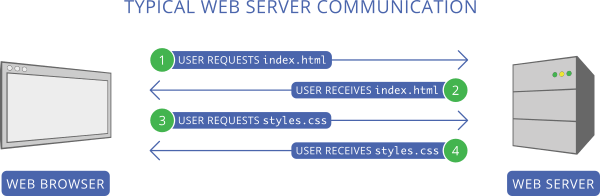
Traditional AJAX works like this:
-
Client sends a request
-
Server responds immediately
-
Connection closes
This is fine for static data, but not suitable for real-time updates like:
-
Chat messages
-
Notifications
-
Live scores
-
Order status updates
To handle near real-time data before WebSockets, developers used polling techniques.
2. What Is Polling? (Basic Idea)
Polling means:
The client repeatedly asks the server: “Any new data?”
There are two main types:
-
Short Polling
-
Long Polling
3. Short Polling (For Understanding)
In short polling:
-
Client sends requests at fixed intervals (e.g., every 5 seconds)
-
Server responds immediately (even if no data)
Example:
Client → Request → Server → “No update”
(wait 5 sec)
Client → Request → Server → “No update”
❌ Wastes bandwidth
❌ Server load increases
❌ Delayed updates
4. What Is Long Polling?
Long polling is an improved polling technique where:
-
Client sends a request
-
Server keeps the request open
-
Responds only when new data is available
-
Client immediately sends another request after receiving response
This creates an illusion of server push.
5. Long Polling Flow (Step by Step)
Step 1: Client sends AJAX request
fetch("/notifications");
Step 2: Server holds the request
-
No data yet
-
Connection stays open
Step 3: New data arrives on server
-
Server sends response immediately
Step 4: Client processes data and re-requests
-
Another long poll starts
Client ─────────────► Server (wait)
Client ◄──── Data ─── Server
Client ─────────────► Server (wait again)
6. Why Is It Called “Server Push”?
Although the client initiates the request:
-
The server decides when to respond
-
Data is sent instantly when available
Hence, it behaves like server push.
7. Key Characteristics of Long Polling
| Feature | Long Polling |
|---|---|
| Real-time feel | Yes |
| HTTP-based | Yes |
| Persistent connection | Temporary |
| Bandwidth efficient | More than short polling |
| Complexity | Medium |
8. Example Use Case (Easy to Visualize)
Chat Application
-
User A sends message
-
Server immediately responds to waiting long-poll request
-
User B receives message instantly
-
New long-poll request is started
This avoids constant “Are there messages?” requests.
9. Long Polling vs Short Polling (Exam Table)
| Aspect | Short Polling | Long Polling |
|---|---|---|
| Request frequency | Fixed intervals | Event-based |
| Server load | High | Lower |
| Response delay | Possible | Minimal |
| Efficiency | Low | Higher |
10. Limitations of Long Polling (Very Important)
❌ Each update still requires a new HTTP request
❌ Server resources held while waiting
❌ Not scalable for very large users
❌ Complex server-side logic
This is why modern apps prefer WebSockets or Server-Sent Events (SSE).
11. Long Polling vs Modern Server Push
| Technique | Connection | True Push | Usage |
|---|---|---|---|
| Long Polling | Repeated HTTP | No (simulated) | Legacy |
| SSE | Persistent | Yes (one-way) | Notifications |
| WebSockets | Persistent | Yes (two-way) | Chats, games |
12. Exam-Friendly One-Line Definitions
-
Long Polling:
A technique where the server delays its response to an AJAX request until new data is available, enabling near real-time updates.
-
Server Push (Simulated):
A method where the server sends data to the client as soon as it becomes available without continuous client polling.
13. Why Students Must Learn This
-
Common AJAX theory question
-
Helps understand real-time web evolution
-
Explains how apps worked before WebSockets
-
Appears in difference-based exam questions
14. Key Line to Remember for Exams
Long polling reduces unnecessary requests by holding the connection open until data is ready, unlike short polling which checks repeatedly.
