
AJAX - JSONP (JSON with Padding) for Legacy Cross-Domain Support
1. Why Was JSONP Needed?
In early web development, browsers strictly enforced the Same-Origin Policy:
-
JavaScript running on one domain could not make AJAX requests to another domain.
-
CORS did not exist at that time.
However, one thing was allowed:
-
<script>tags could load JavaScript from any domain.
JSONP was invented as a workaround using this rule.
2. What Is JSONP? (Simple Definition)
JSONP (JSON with Padding) is a technique where:
-
Data is sent from a server as JavaScript code
-
Wrapped inside a callback function
-
Loaded using a
<script>tag instead of XMLHttpRequest
It is not true AJAX, but it achieves cross-domain data loading.
3. Basic Idea (Very Important to Understand)
Instead of returning:
{ "name": "Vidhi", "age": 21 }
The server returns:
callbackFunction({
  "name": "Vidhi",
  "age": 21
});
The browser:
-
Loads this as JavaScript
-
Executes it automatically
-
Calls the function with the data
4. Step-by-Step JSONP Flow
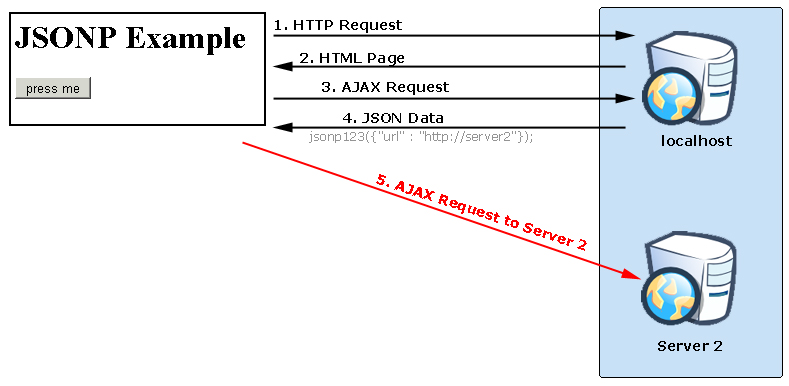
Step 1: Client creates a callback function
function handleData(data) {
  console.log(data);
}
Step 2: Client adds a script tag dynamically
<script src="https://api.example.com/user?callback=handleData"></script>
Step 3: Server responds
handleData({
  "name": "Vidhi",
  "age": 21
});
✔ Data received
✔ Cross-domain allowed
✔ No CORS required
5. Why JSONP Works (Key Reason)
-
Browsers do not block cross-domain
<script>tags -
Script content is executed, not fetched as data
This loophole enabled JSONP.
6. Limitations of JSONP (Very Important for Exams)
| Limitation | Explanation |
|---|---|
| Only GET requests | Cannot send POST, PUT, DELETE |
| Security risk | Executes remote JavaScript |
| No error handling | Cannot detect 404/500 properly |
| No headers | Cannot send auth headers |
| Not real AJAX | No XMLHttpRequest |
7. Security Risk Explained Simply
Since JSONP executes JavaScript:
-
A malicious server can send harmful code
-
This can cause XSS attacks
Example danger:
alert("Hacked!");
stealCookies();
Because of this, JSONP is unsafe by modern standards.
8. JSONP vs CORS (Exam Comparison)
| Feature | JSONP | CORS |
|---|---|---|
| Cross-domain support | Yes | Yes |
| HTTP methods | GET only | All |
| Security | Low | High |
| Error handling | Poor | Proper |
| Modern usage | No | Yes |
9. Is JSONP Still Used Today?
❌ No (almost never)
It is considered:
-
Legacy
-
Insecure
-
Obsolete
But:
-
Still asked in exams
-
Still appears in old systems
-
Important for conceptual understanding
10. One-Line Exam-Friendly Definition
JSONP is a legacy technique that enables cross-domain data retrieval by wrapping JSON data inside a callback function and loading it via a script tag.
11. When Should You Mention JSONP in Answers?
-
When explaining cross-domain communication before CORS
-
When asked: “How was cross-origin handled earlier?”
-
In theory exams (BCA / MCA / Web Technology)
12. Key Point to Remember
JSONP bypasses same-origin policy by exploiting the fact that
<script>tags can load cross-domain JavaScript.
