
Software Testing - Continuous Testing in CI/CD Pipelines
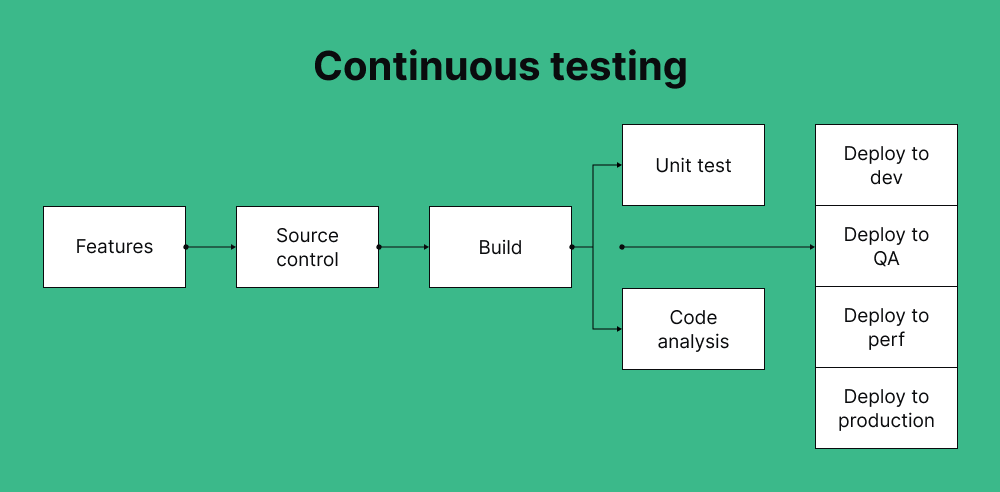
Continuous Testing (CT) is the practice of executing automated tests at every stage of a CI/CD pipeline to provide fast, reliable feedback on quality and risk. The goal is to detect defects as early as possible and prevent broken code from reaching production.
What “Continuous” Means (Precisely)
-
Tests run automatically on every code change (commit, pull request).
-
Feedback is immediate and actionable.
-
Testing is shifted left (earlier) and shifted right (monitoring after release).
Where Tests Run in a CI/CD Pipeline
-
Code Commit (CI Trigger)
-
Static checks (linting, formatting)
-
Security scans (SAST)
-
Unit tests (fast, isolated)
-
-
Build Stage
-
Build verification tests
-
Dependency checks
-
Code coverage enforcement (quality gates)
-
-
Integration Stage
-
Integration tests
-
API tests with mocks/stubs
-
Contract tests (producer–consumer)
-
-
System / Pre-Prod Stage
-
End-to-end (E2E) tests
-
Performance smoke tests
-
Accessibility checks (baseline)
-
-
Release & Post-Release
-
Canary/blue-green checks
-
Synthetic monitoring
-
Continuous monitoring and rollback signals
-
Key Characteristics
-
Automation-first: Manual testing is minimized in the pipeline.
-
Fast feedback: Tests are optimized for speed (fail fast).
-
Risk-based: Heavier tests run later; critical paths prioritized.
-
Repeatable: Same tests, same environment definitions (IaC).
Core Benefits
-
Early defect detection → lower cost
-
Fewer regressions → stable releases
-
Faster delivery → shorter lead time
-
Objective quality signals → data-driven decisions
Quality Gates (Important)
A quality gate blocks the pipeline if thresholds are not met, e.g.:
-
Minimum unit test pass rate
-
Minimum branch coverage
-
No critical security issues
-
Performance within SLA
If a gate fails → pipeline stops.
Best Practices (Concise)
-
Keep unit tests <1–2 minutes
-
Use test pyramids (more unit, fewer E2E)
-
Isolate tests with mocks where possible
-
Run parallel tests
-
Make failures diagnosable (logs, screenshots, traces)
-
Avoid flaky tests; quarantine and fix immediately
Common Mistakes to Avoid
-
Running all tests on every commit (slow pipelines)
-
Relying heavily on UI tests
-
Ignoring test failures to “keep velocity”
-
No ownership for broken pipelines
